Ordering custom wrapping paper in bulk comes down to one translation: turning “how many gifts do we wrap” into “how many linear feet do we buy,” while making sure the roll is wide enough that your boxes actually fit. Get those two numbers right and a single order can carry a boutique or gift counter through an entire season. Get them wrong and you either run out mid-December or store a pallet of paper you paid to overbuy.
The math is not complicated, but it has a few moving parts: the paper each gift consumes, the width of the roll relative to your largest box, and the roll length you choose. The figures below are indicative rules of thumb and standard stock sizes, not a specific product spec. Boxes, wrapping style, and how tightly your staff fold will shift the real numbers, so treat this as a way to size an order and then confirm with a sample run.
The paper one gift actually consumes
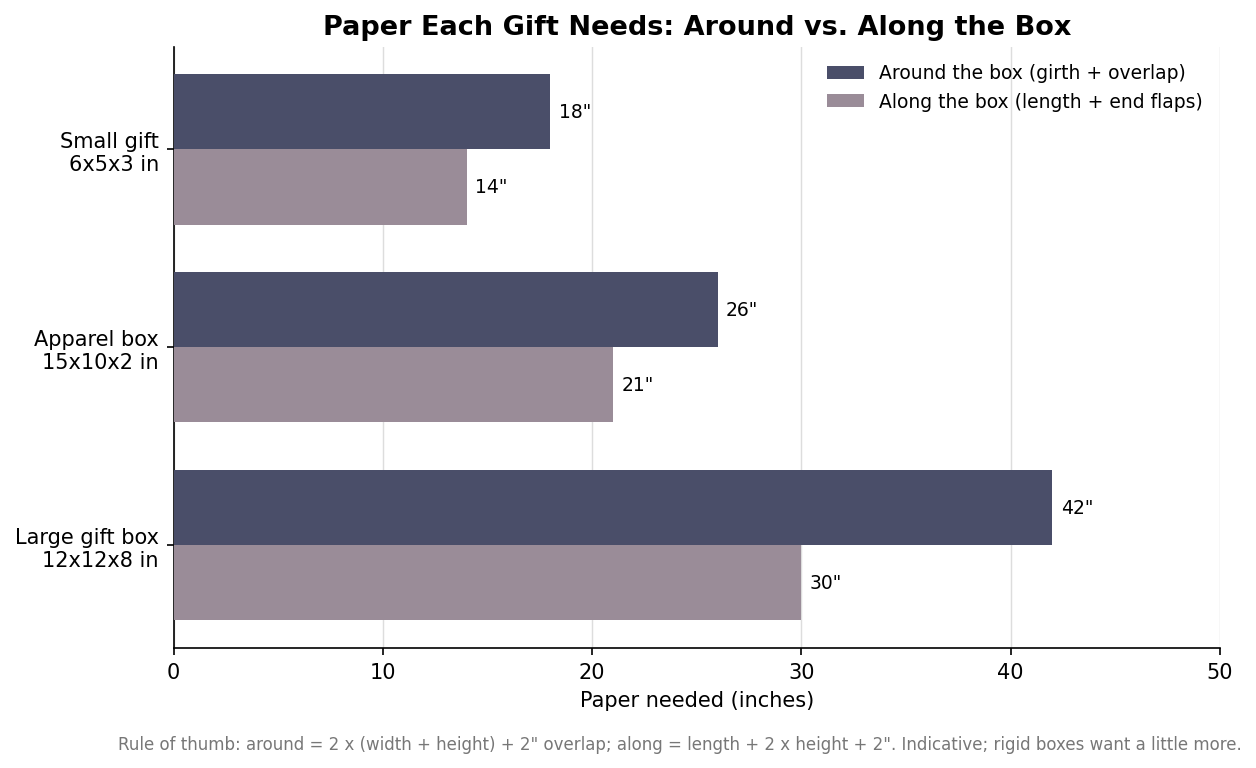
Every wrapped box needs paper in two directions. It has to reach around the box and overlap itself, and it has to extend past each open end far enough to fold the flaps up and meet. A reliable rule of thumb is that the paper going around the box equals two times the box width plus two times the box height, with about two inches added for the seam overlap. The paper running along the box equals the box length plus two times the box height, again with a couple of inches of margin so the end folds close cleanly.
Those two formulas do most of the work. A small 6-by-5-by-3-inch gift needs roughly an 18-by-14-inch piece; a flat 15-by-10-by-2-inch apparel box needs about 26 by 21 inches; a bulky 12-by-12-by-8-inch box climbs to around 42 by 30 inches. The chart below shows how quickly the “around” dimension in particular grows as boxes get deeper, which is the number that most often dictates how wide a roll you need.
Roll width: match it to your biggest box
Wrapping paper is sold by width across the roll and length down it, and the width is the constraint that quietly ruins orders. Standard retail widths run from about 18 inches up through 24, 26, 30, and 36 inches. Twenty-four inches is the common default for apparel and shirt boxes, while 30 inches handles giftware and larger items. If your widest gift needs a 42-inch wrap around its girth but you bought a 24-inch roll, no amount of length will help, because the paper simply cannot reach around the box in one piece.
Buy the width for your largest routine box, not your average one. A slightly wider roll costs a little more per foot and creates a bit more trim waste on small gifts, but it keeps every box on your counter wrappable from a single roll. Splitting into two widths only pays off when a clear majority of your volume is small and a wide roll would waste real material on it.
Roll length: reams, half-reams, and cutter boxes
Length is where bulk paper is priced, and it comes in a few standard configurations. A cutter box roll is typically about 100 feet and suits low volume or a pop-up. Quarter, half, and full reams step up from there at roughly 208 feet, 417 feet, and 833 feet respectively. A full ream at 833 feet is nearly 10,000 inches of paper, which is a lot of gifts, but only if the width fits your boxes and you have somewhere to store the roll.
Weight matters here too. Gift wrap is commonly printed on stock in the range of about 35 to 60 pounds basis weight. Lighter 35-to-40-pound papers cost less and work for small, light gifts, while heavier 50-to-60-pound stocks give better opacity so dark boxes do not show through, and they hold a crisp fold, which reads as more premium on a retail counter. Heavier paper also weighs more to ship, so the choice trades cost and freight against finish.
How many gifts does a roll wrap?
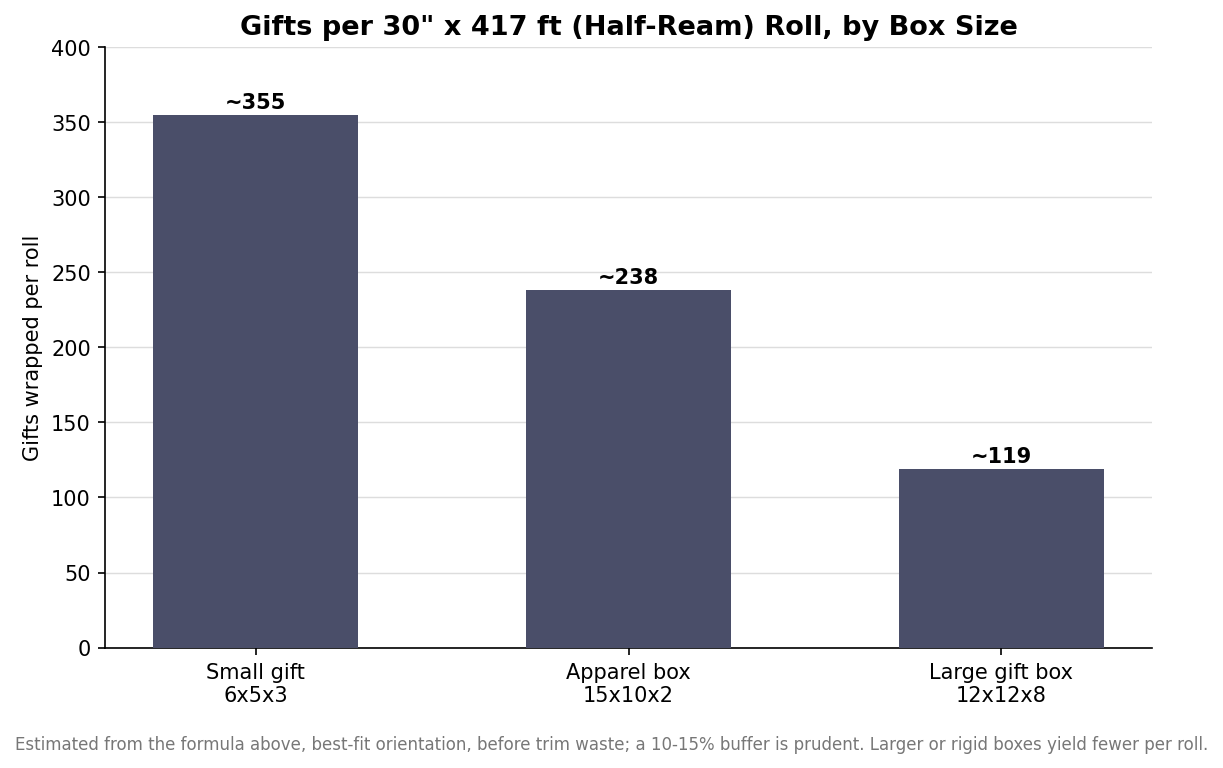
Combining the per-gift consumption with a roll length gives a usable estimate. Take a 30-inch by 417-foot half-ream, which is 5,004 inches of length, and wrap it around the three example boxes. Cutting each piece in its most efficient orientation, the small gift yields roughly 355 wraps, the apparel box about 238, and the large box only around 119. The chart below shows that spread.
The lesson is that box size drives the count far more than most buyers expect, so estimate against your actual mix rather than a single average. It is also why a realistic order adds a buffer. Real wrapping produces trim waste, mis-cuts, and the occasional re-wrap, so building in roughly 10 to 15 percent over your calculated need keeps you from running short at the worst possible time.
Turning it into an order
Put the pieces together in sequence. Estimate your gift volume for the season and break it into rough size buckets, because a counter that wraps mostly small jewelry boxes and one that wraps mostly apparel boxes will consume paper at very different rates. Apply the per-gift wrap length to each bucket, total the inches, convert to feet, and add the buffer. That total tells you how many reams or half-reams to order; the width of your largest common box tells you which roll width to order them in.
Finally, weigh design and print method against quantity, since a custom repeat pattern printed at ream volumes behaves differently on cost than a short cutter-box run, and confirm a physical proof before committing to a long roll. A pattern that looks balanced on screen can reveal an awkward seam or a color shift once it is printed across 30 inches and rolled out by the hundreds of feet. Ordering a short proof run first is far cheaper than discovering the problem on a full ream.