Custom wrapping paper looks like one of the simpler things a brand can order, which is exactly why it goes wrong so often. The design gets all the attention, the logistics get none, and the mistakes only surface after the money is spent: a print method that made the small run cost triple what it should have, a quantity that ran out halfway through the holiday rush, or a gorgeous foil that no customer can recycle. None of these are design problems. They are ordering problems, and every one of them is avoidable if you know where buyers reliably trip. Here are the five that cost the most, and how to sidestep each.
1. Picking the print method that is wrong for your quantity
The single most expensive mistake is matching the printing process to the wrong run size. Digital printing carries no plate costs, so it is cheapest for short runs and the only sensible choice under a few hundred pieces. Flexographic printing needs a plate for every color, typically fifty to two hundred dollars each, so a four-color job can start with several hundred dollars of setup before a single sheet prints. That setup is dead weight on a small order and a bargain on a large one, because flexo’s per-piece cost keeps falling as volume climbs.
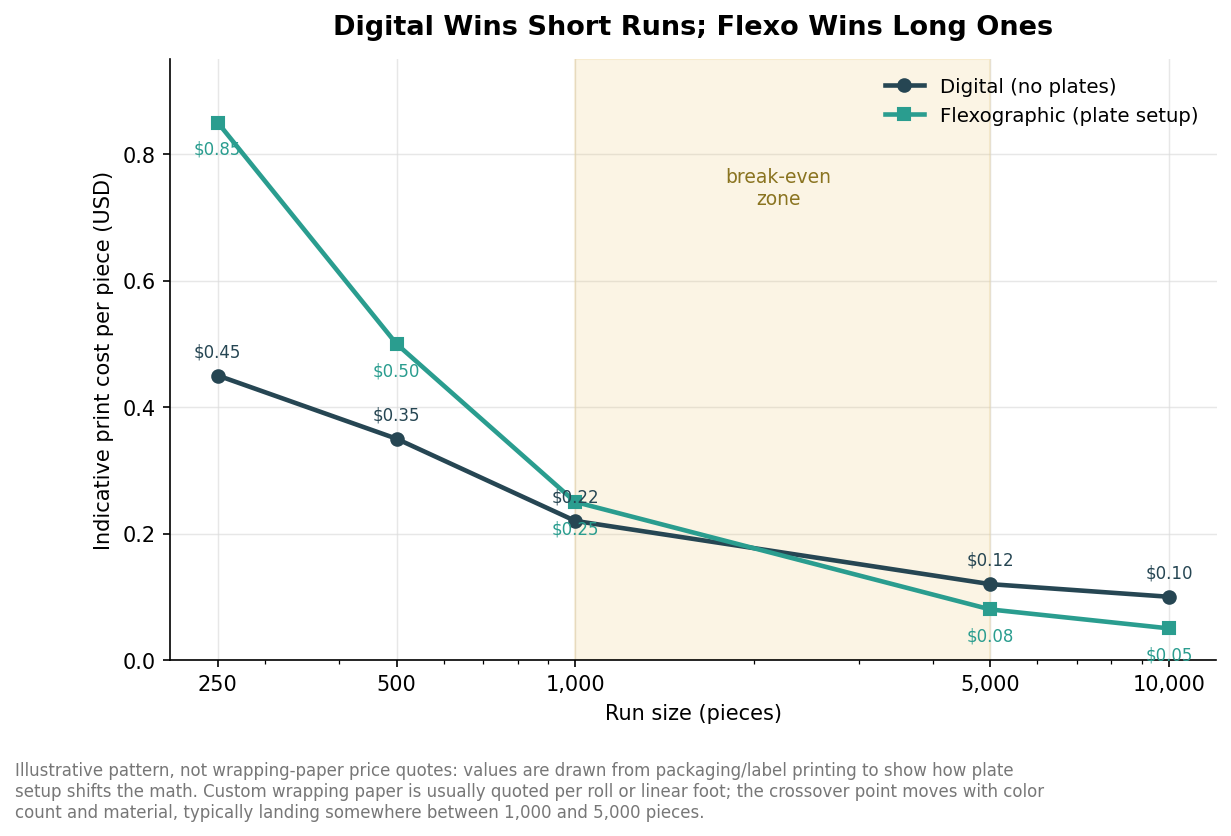
The crossover where flexo overtakes digital usually lands somewhere between 1,000 and 5,000 pieces, moving with color count and material. The values above come from packaging and label printing and are meant to show the shape of the decision rather than quote wrapping-paper prices, which are normally given per roll or linear foot. The takeaway holds regardless: ask any supplier for both a digital and a flexo quote at your real quantity, and let the break-even, not habit, pick the process.
2. Guessing the quantity instead of doing the coverage math
The second mistake is ordering by gut. Buyers picture a stack of rolls and guess, then either run short at the worst possible moment or sit on a year of dead inventory. A few minutes of arithmetic beats the guess every time, because roll coverage is predictable. A standard 30-inch retail roll holds about 2.5 square feet of usable paper per foot of length, and an average gift eats more than you expect.
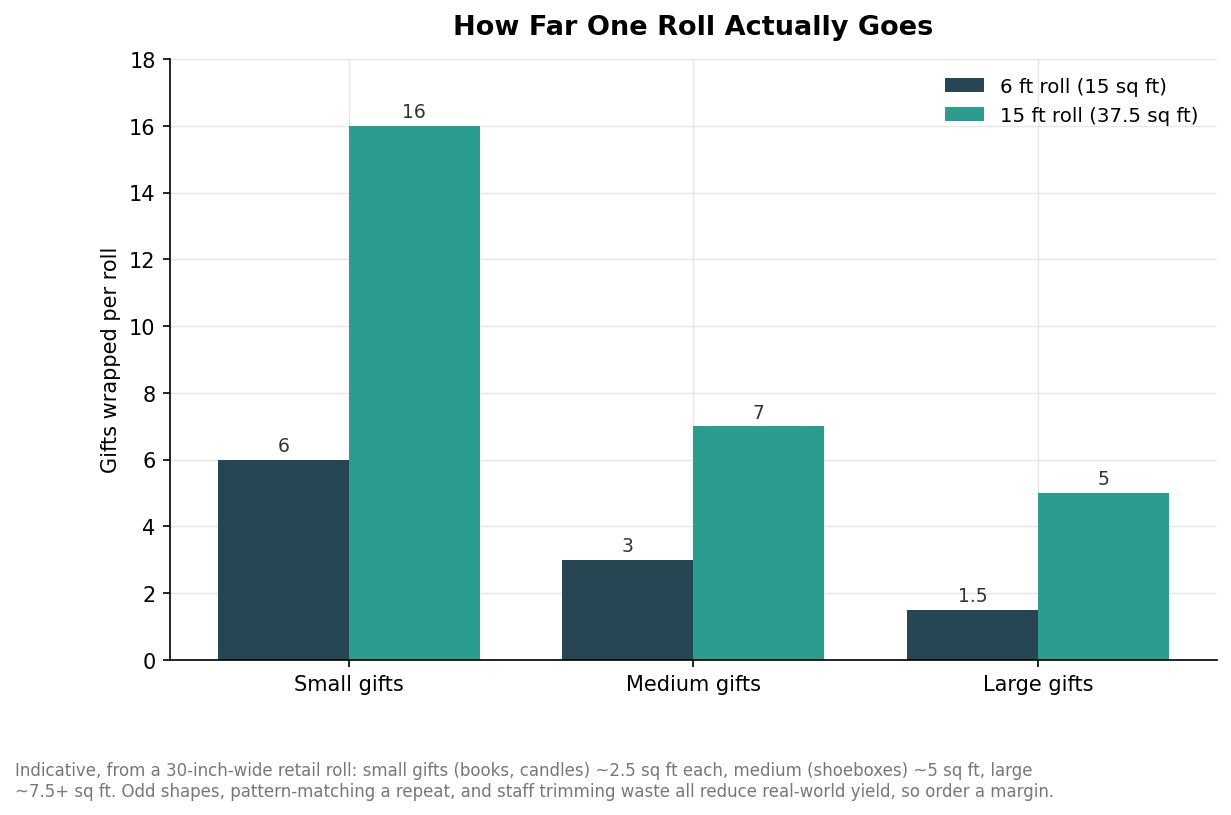
Figure roughly two and a half square feet for a small gift, five for a medium one, and seven and a half or more for a large box. Count the gifts you actually wrap in a season, add a real-world waste margin because odd shapes and pattern-matching a repeat both eat paper, and only then convert to rolls. Ordering a little long on a custom run is usually wiser than ordering short, since a reorder means paying the setup again and waiting out another lead time.
3. Treating foil like a free upgrade
Foil and heavy metallic coatings photograph beautifully, and buyers reach for them without weighing the trade-offs. The first is recyclability: metallized and laminated papers generally cannot go in curbside recycling the way uncoated or kraft stock can, which matters increasingly to gift recipients and to brands that market themselves as sustainable. The second is durability in an unexpected direction, since foil shows every crease, fingerprint, and scuff, so a bright metallic sheet can look worse after handling than a matte one. The third is print fidelity, because fine detail and subtle gradients are harder to hold on a reflective surface. Foil has a real place for premium, low-volume presentation, but choose it on purpose, knowing the cost, the recycling limitation, and the handling fragility, rather than as a reflexive step up from plain stock.
4. Underestimating lead times and seasonal capacity
Timing is where good plans quietly fall apart. Digital runs typically turn around in three to five business days once art is approved, but flexographic runs need roughly seven to ten, and both numbers assume the art is truly final. Add time for a physical proof, at least one round of revisions, and shipping, and a “quick” order can stretch to a month. The trap is seasonal: printers book solid heading into the fourth quarter, so the same job that turns in ten days in spring can take far longer in November when everyone wants holiday paper at once. If your paper is tied to a date, work backward from it, place the order weeks earlier than feels necessary, and confirm the production window in writing rather than assuming the standard turnaround will hold during peak season.
5. Skipping the printed proof
The last mistake is approving a design on screen and never seeing it on paper. Color is the usual casualty. A screen glows; paper does not, and inks that look vivid on a monitor come back muted, especially on kraft stock, where the brown substrate shifts every color and can swallow light inks entirely unless you plan a white underprint or knockouts. Registration is the other risk, since a repeating pattern that looks perfect in the file can reveal seams or misalignment once it prints and tiles across a full sheet. A printed proof or a short press check catches both while they are still free to fix. The figures throughout this piece are indicative and meant to get you into the right range, but the proof is the one step that turns a good plan into a good print. Treat it as mandatory, not optional, and the other four mistakes on this list become far easier to catch before they cost you.